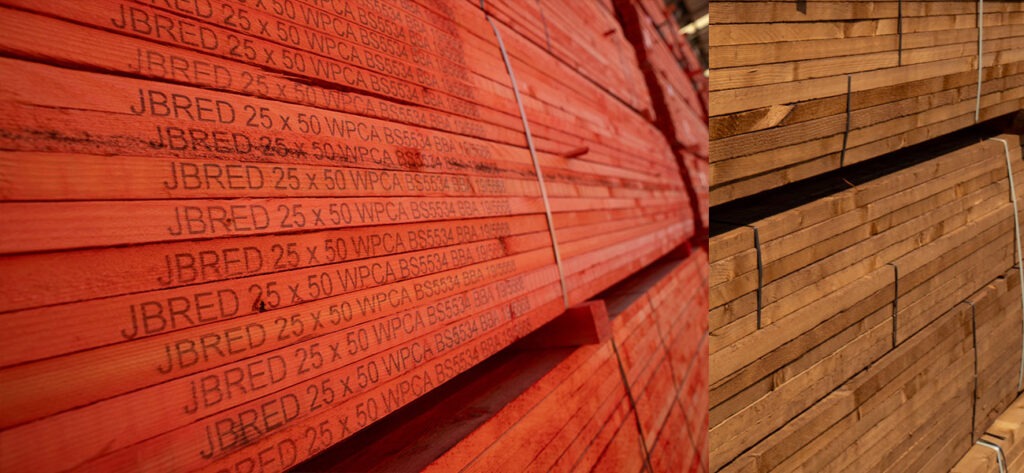


Counter battens can play an important role in providing additional ventilation and moisture management in some types of roofs. With so much riding on these apparently simple lengths of timber, it’s essential to know when counter battens are required, what products to use and how to install them. Below, we answer some of the most frequently asked questions about counter battens in pitched roofs.
What are counter battens?
Counter battens are lengths of timber, normally ranging from 50mm x25mm up to 50mm x 50mm, that run directly over or parallel to the rafters in pitched roofs, from the ridge to the eaves. They are often fixed directly to rafters and may also be fixed to the structural roof deck above or between rafters. Depending on the design of the roof, they can be positioned above or below the underlay.
Why are counter battens used in pitched roofs?
Counter battens serve two main purposes in pitched roofs. One is to create a continuous free air gap to help remove water vapour in the roof space and thereby reduce the risk of condensation. The other is to ensure effective drainage of any water that may get through the roof covering to the eaves.
Do counter battens improve drainage?
Yes. In some roof build-ups without counter battens, there may not be enough space for adequate drainage. This is often the case in low-pitched roofs or where insulation is installed close to the roof covering. Without a suitable drainage gap, moisture can accumulate, risking damage to the insulation layer and other roofing materials.
Counter battens improve drainage by providing a clear route for water to flow down the roof slope from the ridge to the eaves. They can be installed below the underlay and on top of the boarding or insulation, with the underlay then laid to a slight drape, or they can be installed on top of the underlay and boards to create a 25-50mm gap behind the battens.
Do counter battens improve roof ventilation?
Installing counter battens creates a continuous void beneath the roof covering. This allows air to move more freely along the roof slope and can support passive ventilation within the roof build-up.
However, it is essential to understand that counter battens alone do not replace dedicated ventilation measures such as eaves ventilation systems, ventilated dry ridge systems and tile vents, and so, they should not be solely relied on to meet the ventilation requirements of BS 5250:2021, the code of practice for the management of moisture in buildings.
Are counter battens always required?
No, counter battens are not always required.
In many roof build-ups, the roofing membrane is installed over unsupported or ‘open’ rafters which means it can be draped slightly to create effective drainage channels behind the tiling battens.
Some roofs with sarking boards may not require counter battens if there is an adequate drainage gap beneath the roof covering, for example, where natural slates are fixed directly to sarking boards in Scottish practice.
Whether counter battens are needed will depend on the roof design and build-up. Considerations include where the insulation is to be installed, the type of roof membrane, the method of installation and the type of roof covering.
Careful consideration should be given to introducing counter battens to an existing roof as they can increase the height of the roof and cause complications with regards to matching in with adjacent properties, fascia board and gutter height, flashing levels, roof windows and other similar details.
How are counter battens fixed?
Counter battens should be fixed at 600mm maximum centres, with non-corrosive screws or nails with sufficient length and pull-out resistance to meet the specific wind loading requirements of the site.
Do counter battens need to be graded and marked?
While tiling battens must be graded and marked in accordance with BS 5534, the requirements for counter battens will depend on how they are being used.
If counter battens are fully supported by the rafters and are not carrying bending loads, they do not need to be marked or graded. Conversely, if the counter battens are used to restrain insulation boards or are otherwise subject to structural loading, then they should be appropriately marked and graded.
Do counter battens need preservative treatment?
Yes. Since one of the main purposes of counter battens is to provide drainage, moisture exposure is likely. Preservative treatments reduce the risk of decay and support long-term performance.
Where can I learn more about counter battens for pitched roof applications?
The Marley range of roofing products includes JB Red factory-graded roofing battens, which are also suitable for use as counter battens up to 50mm x 25mm (sizes above this are not currently graded to BS5534). If you’d like to find out more about our roofing battens, please visit the product page. To discuss using counter battens on your next roofing project or for other technical support, please contact our team.